
Fishing Time strategy: how the bets actually behave
Fishing Time runs on a certified RNG with a 4% house edge. No strategy on this page can make it profitable, and anyone claiming otherwise is selling you something. What follows will not change your expected return by a single percentage point.
What it will do is change the shape of your session: how often you win, how big those wins are, how long your money lasts and how violently your balance swings. Those are real, controllable variables, and choosing them deliberately instead of by accident is what "strategy" means in a game like this.
Everything below is built on one table of numbers. Nothing else about the game matters as much as these five rows, because sector count is the only lever that sets how often you win.
| Bet | Sectors | Hit chance | Once every | Pays |
|---|---|---|---|---|
| One fish colour | 23 | 42.59% | 2.3 | x2 |
| Both fish colours | 46 | 85.19% | 1.2 | x2 on one chip |
| Big Catch | 4 | 7.41% | 13.5 | x3-x150 |
| Huge Catch | 3 | 5.56% | 18 | x5-x300 |
| Mega Catch | 1 | 1.85% | 54 | x10-x1,000 |

The sums BGaming doesn't publish
BGaming publishes two things: a 96.00% RTP and the payout range for each sector group. It doesn't publish the return of each bet on its own, or the multiplier mix inside the bonus rounds. The sector counts are known though, and that's enough to work out something useful.
Start with the fish bet, because it's fully determined
A single fish colour covers 23 of 54 sectors and pays a flat x2. There is no range and no hidden distribution, so the return is simply:
That gap has to come from somewhere, and the only candidate is the random x2-x10 multipliers. Which tells you something the marketing doesn't: random multipliers are not a bonus extra on fish bets. They're part of the advertised return. Flat-bet a colour through a stretch with no multiplier luck and you're playing an 85% game.
We can even estimate how often they appear. Closing 10.81 points with multipliers averaging about x6 (the midpoint of x2-x10) requires them on roughly 2.5% of winning rounds, about one in forty. Rare events doing heavy lifting.
Now work backwards to the bonus rounds
Wheel games are usually built so every betting option carries the same house edge. That's how roulette works, and it's a fair default. If each Fishing Time bet also returns 96%, then for any tier: average payout = 0.96 ÷ hit chance. That gives us the averages BGaming won't publish:
| Tier | Hit chance | Published range | Implied average | Inside its range? |
|---|---|---|---|---|
| Big Catch | 7.41% | x3 - x150 | x12.96 | Yes |
| Huge Catch | 5.56% | x5 - x300 | x17.28 | Yes |
| Mega Catch | 1.85% | x10 - x1,000 | x51.84 | Yes |
All three land comfortably inside their published ranges. That is a real consistency check: had the equal-edge assumption been badly wrong, at least one figure would have fallen outside its bracket or sat absurdly close to an endpoint. The published ranges themselves are on the bonus features page.
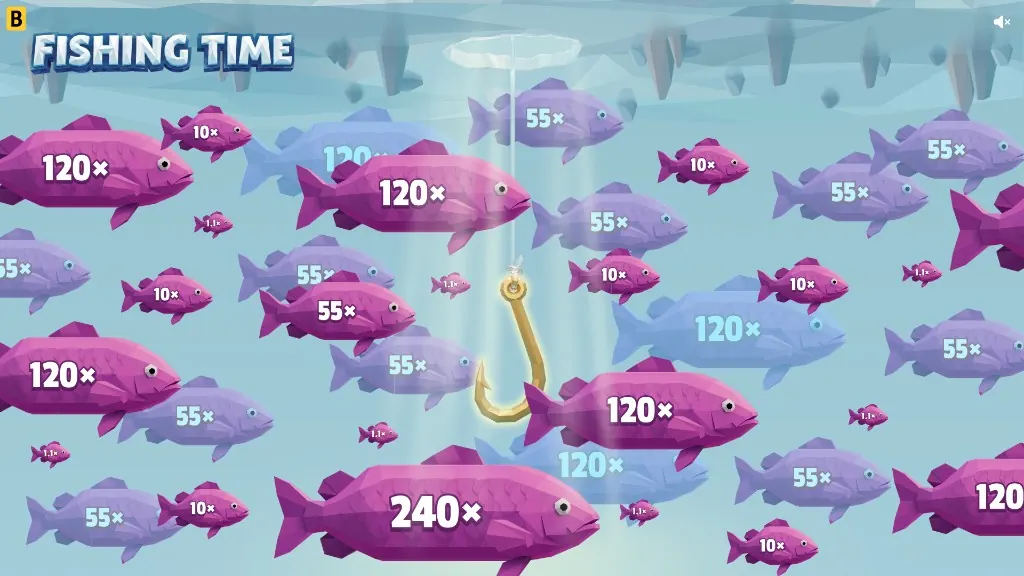
Takeaway: a Mega Catch trigger is worth around x52 on average, not the x1,000 the marketing leads with. The top of every bonus range is a genuine outlier, and the distributions must be heavily skewed toward their floors for these averages to hold. Expect x10-x30 from a typical Mega Catch and treat anything above x200 as a rare event.
Caveat: this rests on the equal-edge assumption. If BGaming deliberately varies the edge between options, the real figures differ. And because random multipliers also boost bonus payouts, the base averages inside the bonus rounds are probably a little lower than the numbers above. Treat these as well-reasoned estimates with the working shown, not as facts.
Run your own session simulator
Rather than telling you what a session "usually" looks like, here is a model you can run yourself. It spins a real 54-sector wheel thousands of times in your browser using the published sector counts and the implied averages derived above.
Exact arithmetic
- Sectors covered
- -
- Win frequency
- -
- Total staked
- -
- Chance of ≥1 Mega
- -
Modelled outcome
- Median result
- -
- Typical spread
- -
- Sessions in profit
- -
- Simulated
- -
How to read this. "Exact arithmetic" is pure calculation on the 54 sector counts and is not in doubt. "Modelled outcome" depends on our estimated bonus multiplier distributions, so treat it as indicative rather than precise. Results are expressed as a percentage of total turnover: −100% means every chip staked was lost, 0% means you broke even. "Typical spread" is the 5th to 95th percentile: one session in twenty finishes outside it in each direction.
First, set the approach to one fish colour and push the rounds from 50 to 5,000. The median climbs from about −8% to roughly −4%, the spread collapses to a narrow band entirely below zero, and sessions finishing in profit fall to almost none. Grind a flat, low-payout bet for long enough and you don't approach breaking even. You approach losing exactly 4%.
Second, hold the rounds at 5,000 and switch to Mega Catch only. The median does not settle at −4%; it lands near −12%, materially worse. Yet sessions finishing in profit go up, to roughly one in three. Both bets return the same 96%, so neither is the better wager. It's the same edge wearing a different shape.
The Mega Catch average is propped up by rare, enormous hits. Remove them and what is left is a long tail of sessions losing far more than 4%, so the typical (median) result sits well below the average (mean) one. Most players on that bet do worse than the RTP suggests and a few do dramatically better. Reading 96% as "I should expect to lose about 4%" is only sound on the flat colour bets, which have almost no tail to distort them.
Figures quoted above come from runs of this simulator and shift by a point or two each time, because every run is a fresh set of sessions rather than a cached result. The direction and rough size of the gap are stable; the exact decimals are not.
How long "the long run" really is
To put a number on that slowness: we ran the model for four million rounds per betting option. The fish bets landed within 0.1 points of 96%, but Mega Catch came out at 93.8%, over two points low, purely from chance. The closed-form expectation for all five bets is exactly 96.00% and we verify it on every build, so this is not a modelling error. It is how brutally slowly a 1-in-54 bet with a 1,000x tail converges.
Over any session you will actually sit through, variance dominates the house edge completely. The 4% is real and unavoidable, but it is a rounding error next to the swing of a few hundred rounds. Two consequences follow: bankroll sizing and knowing when to stop matter far more than which sector you back, and a winning session is never evidence that your approach works. It's the expected behaviour of a game with this much noise in it.
Strategy 1: low risk, steady wins
How to play it
- BetOne fish colour
- Sectors covered23 of 54
- Hit rate42.59%
- Payoutx2 flat
- Chips per round1
- SuitsBeginners, small bankrolls
The trade-off
You get: a win nearly every other round, minimal swings, and the longest possible playing time per euro. You will almost never have a catastrophic session.
You give up: any chance of a memorable win. The ceiling on this bet is x2 plus whatever random multiplier luck brings. You will also never see a bonus round, which is most of what makes this game interesting to watch.
This is the right starting point if you have not played a wheel game before, because it teaches you the rhythm without punishing you. A 42.59% hit rate feels active (roughly two wins in every five rounds) and the flat x2 keeps the arithmetic simple.
It is the bet most exposed to the 85.19% base return. With no bonus access, your entire hope of reaching 96% rests on random multipliers landing on your colour roughly one round in forty. Between those, you are grinding at a considerably worse rate than the advertised RTP. which is why low-risk play here often feels like it loses steadily. It does.
Does backing both colours help?
It is the first idea most players have: cover 46 of 54 sectors and win 85% of rounds. It does work as described: you'll win almost every round, but it doesn't improve your position. You stake two chips to win x2 on one of them, so a hit returns exactly what you put in. Break even 85.19% of the time, lose both chips the other 14.81%. Run the arithmetic and it lands on the same 85.19% return.
What it actually buys is the sensation of winning constantly while your balance drifts down. For some players that is a pleasant way to pass time; for others it is the most frustrating configuration in the game. Worth testing in the demo before committing.
Strategy 2: balanced, fish plus bonus coverage
How to play it
- BetOne colour + All Bonuses
- Sectors covered31 of 54
- Hit rate57.41%
- Payoutx2 or x3-x1,000
- Chips per round4
- SuitsIntermediate players
The trade-off
You get: regular small wins from the colour bet funding a genuine shot at every bonus tier. This is how the game is built to be played, and the setup most people enjoy.
You give up: four chips per round instead of one. Your turnover, and therefore your expected cost per round, is four times the low-risk approach.
One chip on a fish colour and one on each bonus tier (or a single tap of All Bonuses) covers 31 of the 54 sectors. You win on 57.41% of rounds, most of them small, but with all three bonus tiers live on every single spin.

The colour bet is high-frequency and low-payout; the bonus bets are the reverse. Running both means the frequent small wins keep the session moving while the bonus sectors provide the outcomes worth remembering. You're not reducing the house edge (nothing does), but you are getting the widest slice of what this particular game has to offer for your money.
Sizing it properly
Because this costs four chips a round, the mistake is keeping the chip value you used when betting one. If €1 flat on a colour felt right, then the equivalent here is €0.25 chips, not €1. Otherwise you have quadrupled your stake without deciding to. Scale the chip down to hold your per-round exposure constant.
A reasonable variant weights the bet: a larger chip on the colour for stability and minimum chips on the three bonus tiers as lottery tickets. That keeps bonus access live on every round at the lowest possible cost.
Strategy 3: high risk, going for Mega Catch
How to play it
- BetMega Catch only
- Sectors covered1 of 54
- Hit rate1.85%
- Payoutx10 - x1,000
- Chips per round1
- SuitsExperienced players only
The trade-off
You get: the only direct route to the game's 1,000x ceiling, at the lowest possible cost per round: one chip.
You give up: 98.15% of rounds. You will lose fifty-three spins in a row on average between hits, and the hit itself averages around x52 rather than x1,000.
One sector, one chip, and a long wait. The appeal is obvious and the arithmetic is brutal in a specific way worth spelling out: this bet has the same 96% expectation as every other, but the variance is so extreme that expectation stops being a useful guide to what will actually happen to you.

What the wait really looks like
| Rounds played | Chance of ≥1 Mega Catch | In practice |
|---|---|---|
| 10 | 17.0% | Most sessions see nothing |
| 37 | 50.0% | The coin-flip point |
| 54 | 63.6% | One "expected" cycle, still a 1-in-3 chance of nothing |
| 100 | 84.6% | Comfortable, not certain |
| 150 | 93.9% | A sensible minimum if this is your plan |
| 250 | 99.0% | Near-certain |
Note the fourth row. Playing exactly 54 rounds, the "once every 54" figure, still leaves a 36.4% chance of never seeing it. Mistaking an average interval for a guarantee is the most common way this strategy goes wrong.

Budget at least 150 rounds of stake, and treat every one of them as already spent. A bankroll that covers 40 rounds is not playing this strategy. You're buying forty lottery tickets and will most likely end with nothing at all. If losing the entire amount without a single trigger would bother you, this is not your bet.
Bankroll rules that actually help
You cannot change the house edge. You can absolutely change how long your money lasts and whether you leave with any of it, and that is where the decisions are.
-
Set a session budget before you open the game
Decide the number first, in a currency amount you would be relaxed about losing entirely, and treat it as the price of the entertainment rather than an investment. Deciding mid-session, while you are up or down, is how budgets stop existing.
-
Size your chip against your round count, not your balance
Work out how many rounds you want, then divide. For bonus-focused betting you want 150+ rounds; for flat colour betting 60-80 is plenty. A €50 bankroll aiming at 150 bonus-coverage rounds means a total round stake near €0.33, so minimum chips across three tiers, not €1 each.
-
Set a loss limit and a profit target, and write them down
A stop-loss around −30% of bankroll and a walk-away point near +50% are reasonable defaults. The specific numbers matter far less than fixing them in advance, because a target decided while you are winning always moves upward.
-
Withdraw a win rather than re-betting it
A x300 Huge Catch is the entire point of playing, and money left in the account will be recycled into a game with a 4% edge until it is gone. Withdrawing it is the only way the win becomes real.
-
Never increase stakes to recover losses
The single most expensive habit in gambling, and the one this game's fast rounds make easiest. Your previous losses have no bearing on the next spin, so raising your stake only increases the rate at which the edge applies. Losses don't become more recoverable, just larger.
-
Watch rounds per hour, not just bet size
Under-appreciated and important. At a 4% edge your expected cost is turnover × 0.04, and turnover is stake × rounds. Autoplay at 100 rounds costs the same as 100 manual rounds but takes a fraction of the time. so an hour of Autoplay can cost several times an hour of manual play at identical stakes. If you want a session to last, slow it down.
Why betting systems fail here
Martingale, Fibonacci, D'Alembert and the rest all rest on the same premise: that a loss makes a future win more likely, so a rising stake can recover it. On an RNG wheel this premise is simply false. Every round is an independent draw from the same 54 sectors, so no sequence of results changes what happens next.
Martingale, with the actual numbers
Doubling after a loss is worse on a fish bet than on a coin flip, because the bet wins only 42.59% of the time while paying x2. Losing streaks are therefore both longer and more frequent than intuition suggests:
| Losses in a row | Probability | Roughly once every | Next stake needed |
|---|---|---|---|
| 5 | 6.24% | 16 sequences | €32 |
| 8 | 1.18% | 85 sequences | €256 |
| 10 | 0.39% | 257 sequences | €1,024 |
| 13 | 0.07% | 1,360 sequences | €8,192 |
A ten-loss streak isn't exotic. It turns up roughly once in 257 sequences, which is well inside a normal week of play. Recovering it needs over €1,000 on a single round from a €1 base, and the table maximum of €250 per sector will stop you long before that. The progression is capped by the rules, not just by your balance, which means the strategy is guaranteed to fail eventually rather than merely likely to.
They redistribute your outcomes: many small wins, punctuated by rare catastrophic losses. Expected value is unchanged (it can't be changed) but the failure mode becomes far more severe. The reason Martingale feels like it works is that you experience the small wins frequently and the wipeout rarely. Both are part of the same system.
How to use the round history panel
A strip of recent results sits beside the betting area. It has one legitimate use and one very expensive misuse.
Legitimate use
- Calibrating your expectations. Watching real dry spells unfold teaches you how long 1-in-54 actually feels, far better than reading the number.
- Confirming the game is behaving. Over a few hundred rounds, bonus sectors should appear roughly 15% of the time. Wildly different would be worth questioning.
- Pacing yourself. Seeing how many rounds have gone by is a useful nudge when a session is running longer than you meant.
Expensive misuse
- "Mega Catch is due." It is not. After 200 rounds without it, the next round is still exactly 1 in 54.
- "Grey is hot." There is no hot or cold. Both colours sit on 23 fixed sectors every single round.
- "I'll wait for a dry spell then bet big." Waiting changes nothing about the next spin, so this is just betting big for no reason.
Independent events have no memory. The wheel does not know what it did last round, does not owe you anything, and does not balance out over any timeframe you will experience. If a long drought pushes you toward a bigger bet, the history panel is costing you money, and the fact that it presents itself as data is exactly what makes it dangerous.
Five mistakes to avoid
-
Treating "once every 54 rounds" as a schedule
It is an average, not a timetable. Play 54 rounds chasing Mega Catch and you still have a 36.4% chance of seeing nothing. Bankrolls built on the average interval run out roughly a third of the time before the thing they were built for happens.
-
Expecting x1,000 from a Mega Catch trigger
The range starts at x10 and the implied average is around x52. Landing the rarest sector on the wheel and collecting x14 feels like being cheated, but it is the normal case. The 1,000x is a ceiling, not an expectation.
-
Forgetting the chip value is per sector
A €5 chip on all five options is €25 that round, not €5. This is the most common way players stake five times what they intended, and the interface will not stop you.
-
Leaving Autoplay running while distracted
A hundred rounds go by fast, and turnover is what the house edge feeds on. Autoplay isn't a different game, but it is a much faster one. which makes it a much more expensive one per hour.
-
Assuming both fish colours is a safe hedge
Covering 46 of 54 sectors sounds like near-certain safety. In fact you break even on every hit and lose both chips on the other eight sectors, for the same 85.19% return as a single colour, with the added risk that constant "wins" mask a steadily falling balance.
Strategy questions
Is there a strategy that beats Fishing Time?
No. Every round is an independent draw with a 4% house edge, so no betting pattern changes the long-run expectation. Bet selection changes the shape of your results (win frequency, win size, bankroll survival), and that is worth picking on purpose even though the edge is fixed.
What is the safest bet?
A single fish colour: 23 of 54 sectors, 42.59% hit rate, flat x2, lowest variance on the wheel. The caveat is that the x2 alone returns 85.19%, with random multipliers making up the gap to 96%, so it grinds down faster than "safe" implies.
Does Martingale work here?
No. A fish bet loses 57.41% of rounds, so streaks are longer than on a coin flip: ten in a row turns up about once every 257 sequences and would need over €1,000 on the next round from a €1 base. The €250 per-sector table maximum caps the progression before the maths can rescue it, which makes eventual failure certain rather than merely likely.
How big a bankroll do I need?
For bonus-focused play, at least 150-200 rounds of stake, because Mega Catch sits on one sector in 54. For flat colour betting, 60-80 rounds shows you the game's normal rhythm. Size the chip from the round count, not the other way round.
Which single bet has the best value?
If every option returns the same 96% (the usual assumption, and our derived averages all sit inside their published ranges), then none does. Pick the outcome shape you want. Huge Catch is the fairest compromise between frequency and ceiling.
Should I use Autoplay?
It changes nothing mathematically and it is convenient. The risk is purely behavioural: it dramatically increases rounds per hour, and since expected cost is turnover × 4%, an hour of Autoplay can cost several times an hour of manual play at the same stake. If bankroll longevity matters to you, play manually.
Is it better to bet one big chip or several small ones?
For expected value, identical: only total turnover matters. For experience, very different: one large chip on a single tier gives you rare, big swings, while several small chips across tiers gives you frequent small movement and wider bonus access. Neither is more profitable, so choose the one that keeps you playing calmly and within your limits.
Try these in the demo first
Every approach on this page can be tried in the free demo with play money. Run each one for fifty rounds and see which you actually enjoy before any of your own money is involved.
18+ only. No strategy overcomes the house edge. Never stake money you cannot afford to lose.